WorkWebsite
Cygilant: security as an agency, not a tool.
A cybersecurity company that called itself the world's first 'Cyber Security Agency', selling enterprise-grade protection to mid-market firms through people, not just software. The category sells fear and acronyms. This homepage had to feel calm, human, and confident enough to make security look like a partnership instead of a product.
- Client
- Cygilant
- Sector
- Cybersecurity / Security-as-a-Service
- Role
- Brand & Site Direction
- Year
- 2019
00The opening
Open with a predator, not a padlock.
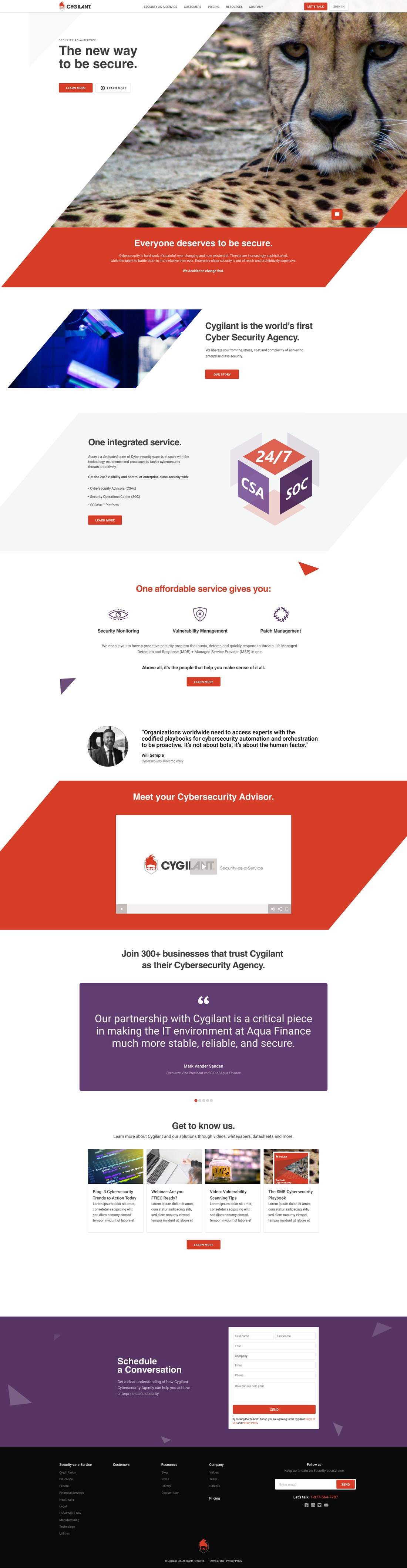
A cybersecurity homepage leads with a cheetah’s face — not a shield, not a lock. “The new way to be secure.” The category defaults to fear and padlocks; this one picks a calm, focused predator. The image stakes a position before a word is read.
01The mission
State the belief, then the resolve.
“Everyone deserves to be secure… We decided to change that.” Enterprise-class security framed as a right, not a luxury — and the company casts itself as the one fixing the imbalance. A mission stated as a decision is harder to argue with than a slogan.
02The category
Invent the category you can lead.
Not a vendor, not a platform — an “Agency.” By borrowing a familiar service model, Cygilant reframes security from a product you buy to a partner you hire. If you can’t win the existing category, name a new one and stand first in it.
03The offering
Bundle the alphabet soup into one promise.
CSAs, a SOC, a SOCVue platform, 24/7 — an industry of acronyms, packaged as “one integrated service.” The page sells the outcome (one team, always on) and files the jargon underneath it. Buyers want the result, not the org chart.
04The thesis
Borrow an outsider to say the brave part.
“It’s not about bots, it’s about the human factor.” — an eBay security exec, not Cygilant. In a market selling automation, the brand stakes the opposite claim and lets a third party carry it. The contrarian line lands harder in a borrowed voice.
05The proof
Pair the number with a name.
“Join 300+ businesses that trust Cygilant,” then one named client — Aqua Finance — calling its IT environment “more stable, reliable, and secure.” Scale and specificity together: the count proves reach, the quote proves it’s real.
06The generosity
Teach before you pitch.
Blogs, a webinar, a vulnerability-scanning video, an SMB playbook — “Get to know us.” For a trust business, giving away expertise is the demo. The page proves competence by being useful before it asks for anything.
07The close
Ask for a talk, not a transaction.
“Schedule a Conversation.” A security sale is a trust sale, so the close is a conversation, not a checkout. The form is short, the tone is calm. The page ends the way it began — secure, unhurried, human.
A brand is a system
or it’s a costume.
Every decision here keeps the user in frame while the work earns its trust. The system holds across every fold, which is the only test that matters.
Want the work to
hold like this?
It starts with an honest read of what you have now. $4,500. Two weeks. Your market, on tape.